
By Jon Radoff
The next wave of decentralized adoption won’t come from file storage, wireless, or IoT—it will come from gaming.
DePIN (Decentralized Physical Infrastructure Networks) promises to reinvent how compute, storage, and bandwidth are delivered. But while most sectors are still exploring use cases, game developers are already proving that decentralized infrastructure can scale to millions of users in real time.
1. The $35B reason why infrastructure matters
Live-service games have become the standard model for the industry. Nearly every major studio now builds persistent worlds that update weekly and monetize over years, not months.
That model comes with a cost: backend infrastructure now represents a $35B annual spend, mostly flowing to centralized providers like AWS, Azure, and Google.
Beamable Network offers a decentralized alternative—cheaper, faster, and more reliable—designed specifically for the unique demands of games.
2. Real adoption, not theory
Beamable Network isn’t a whitepaper. It’s live.
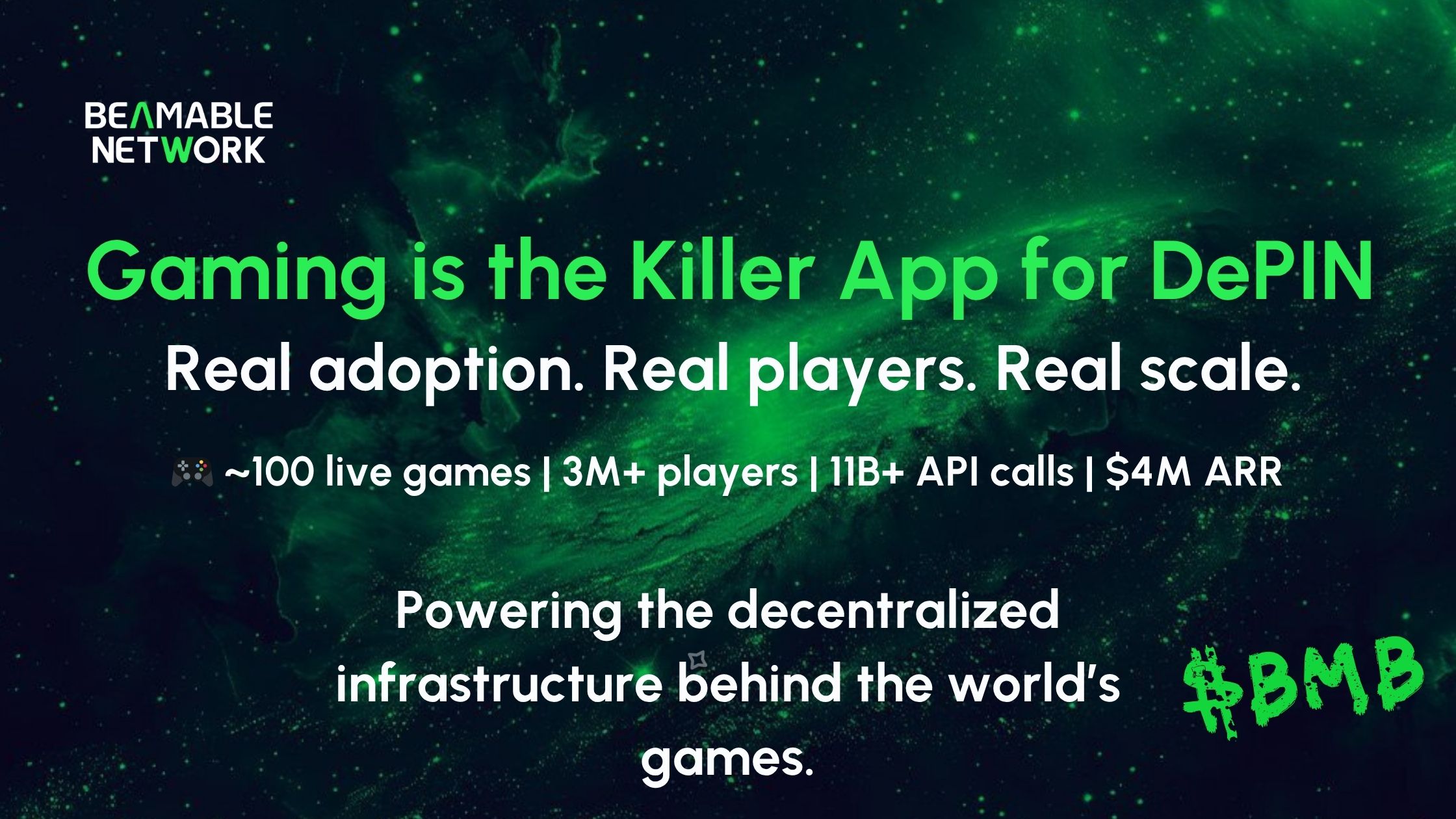
✅ ~100 games already running on the network
✅ 150+ more in development
✅ 3M+ monthly active players
✅ 11B+ monthly API calls
✅ $4M annual recurring revenue
These are not simulations or testnets—they’re production workloads from Web2 and Web3 studios alike. That usage places Beamable among the top 10 DePIN projects globally.
3. Why gaming fits DePIN perfectly
Games are high-intensity, always-on workloads. They require:
- Global low-latency compute
- Persistent data storage
- Secure player identity
- Scalable event handling
Those are precisely the challenges DePIN solves best. Unlike static workloads, games need decentralized infrastructure that can elastically expand to meet player demand—without locking developers into hyperscale pricing or single-vendor risk.
With Beamable Network, studios pay only for what they use, save up to 50–80% over centralized providers, and can deploy across a global network of compute suppliers.
4. Developers gain flexibility, not friction
Game creators want to focus on gameplay—not infrastructure management.
Beamable Network lets them build faster with modular “microservices” contributed by a growing developer community. These reusable backend components cut months off production schedules and help studios launch new live-service titles in record time.
It’s an ecosystem where innovation compounds—each game built strengthens the network for the next.
5. The ripple effect beyond gaming
When gaming proves that decentralized infrastructure can handle massive, latency-sensitive, real-time workloads, it validates DePIN for every other sector—from AI inference to streaming, logistics, and beyond.
Gaming isn’t just the first use case. It’s the proving ground.
Closing Thought
Beamable Network is showing the world that DePIN is ready for scale.
With ~100 games, 3M+ players, and $4M in ARR, the network is disrupting a $35B market and giving developers a faster, cheaper, and more resilient way to build the future of live-service games.
Gaming is the killer app for DePIN—because it’s where decentralization meets demand.
👉 Learn more at Beamable.Network